

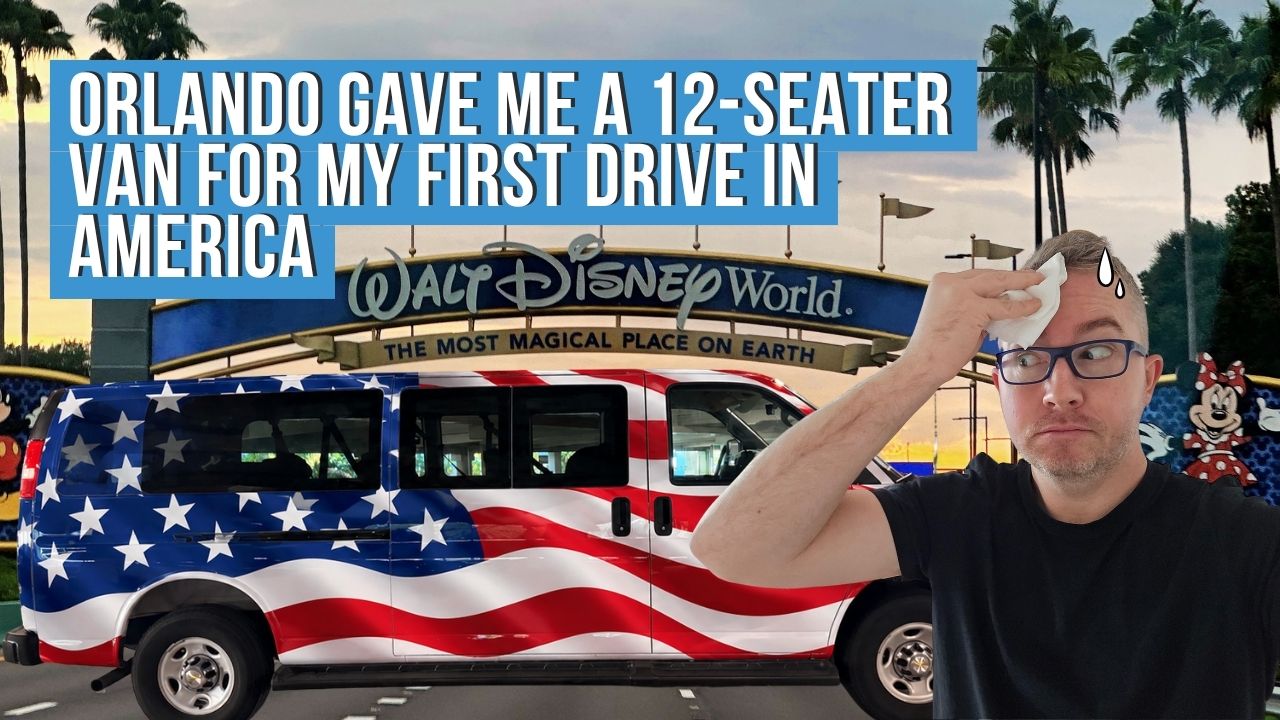
There are probably easier ways to experience driving in America for the first time.
Perhaps a nice Ford Mustang. A quiet road. Daylight. Maybe even a small SUV if you’re feeling sensible.
I went for a 12-seater Chevrolet Express Passenger Van, at night, with eight passengers, five children, a wheelchair, a car seat and enough luggage for a small expedition.
I say “went for”. It wasn’t entirely my first choice.
This was our big family summer holiday from the UK to Orlando, Florida. There were nine of us travelling in total and, before we went, one of the biggest questions was how we were actually going to get around.
Four adults held driving licences, so on paper the obvious answer was to hire two cars.
Except it wasn’t quite that simple.
One person wasn’t particularly comfortable with the idea of driving in certain conditions in America. Another ruled themselves out of driving altogether. Another was happy to drive occasionally, but understandably didn’t want to spend the holiday behind the wheel.
Then there was me.
I like driving. I’ve driven plenty of different cars and I’ve driven vans in the UK when moving house.
How difficult could it be?
Well…
One car or two?
There were some pretty big advantages to hiring two normal-sized cars.
Neither vehicle would be enormous, we could split the luggage between them and there would be more than one regular driver.
But the more I thought about it, the more I liked the idea of keeping everyone together.
With one vehicle, there was no risk of us getting separated or one car taking the wrong exit and disappearing into the Florida wilderness.
My sister is a wheelchair user and has a disability parking badge, so travelling together also meant we could make use of accessible parking as a group. With two cars, we’d potentially have one vehicle parked close by and another somewhere else.
Most importantly for me, there was navigation.
My wife is normally the person sitting next to me telling me where I’m going, reminding me about the turning I’m about to miss and generally keeping me vaguely organised.
If we had two cars, she would probably be driving the other one.
Given that I was about to drive on the opposite side of the road for the first time, in a country I’d never driven in before, I couldn’t think of anyone I wanted sitting next to me more.
There was also the potential extra cost of hiring and insuring two vehicles.
So I bit the bullet.
One vehicle it was.
A 12-seater.
Preparing to drive in Florida
I did what any completely relaxed person would do before a holiday.
I watched loads of videos about driving in Orlando.
I looked at how junctions worked, learned about turning right on a red light where permitted and read up on the main differences between driving in America and the UK.
I went onto Street View and virtually drove around the area near Disney’s All-Star Movies Resort so I could see how wide the roads were, what the junctions looked like and roughly where I would be going.
I downloaded Google Maps for Florida so we’d have offline navigation if the mobile signal disappeared, although we also had roaming data for live traffic information.
I even prepared the children for the fact that Dad was going to need them to be on their best behaviour while he figured out how to drive a small bus on the wrong side of the road.
That should be enough preparation, surely?
Then it got dark
We landed at Orlando International Airport in the early evening, with around an hour of daylight remaining.
Perfect.
Except, of course, getting nine people through an airport takes time.
Then you wait for the luggage.
Then you collect everything.
Then you get everyone together.
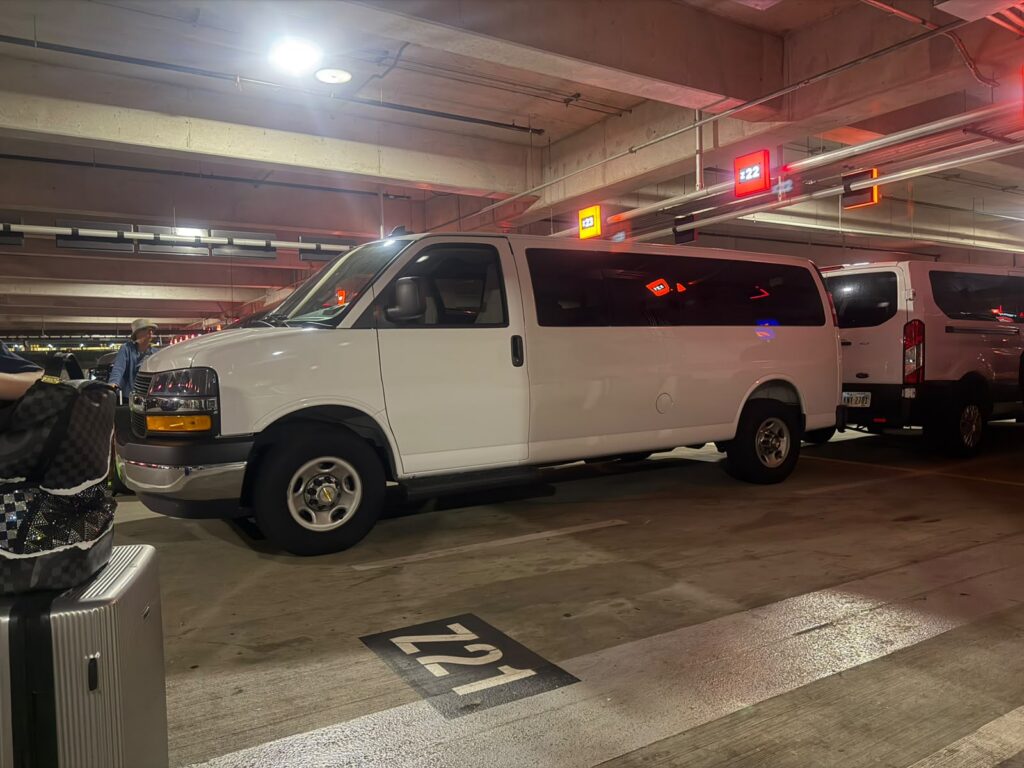
By the time the bags had finally rolled off and we made it to the hire car collection area, it was pitch black.
Brilliant.
I’d booked through Avis and was secretly hoping we’d be given my preferred vehicle, a Ford passenger van.
In my head, the Ford would feel more familiar. The controls would probably make sense. If it was relatively new, perhaps I’d get Apple CarPlay too.
I was given a parking bay number and headed out to find our vehicle.
There it was.
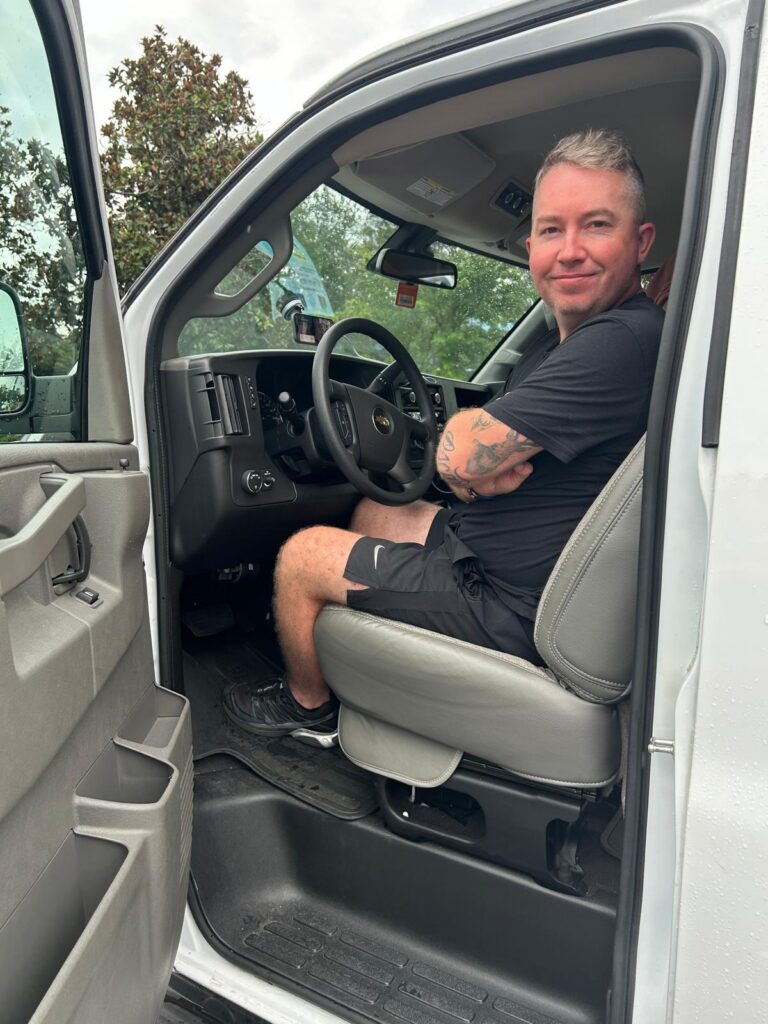
A Chevrolet Express Passenger Van.
It was absolutely enormous.
Americans have a reputation for driving big vehicles. This thing made some of those big American vehicles look small.
I genuinely stood there wondering whether I was actually going to leave the car park.
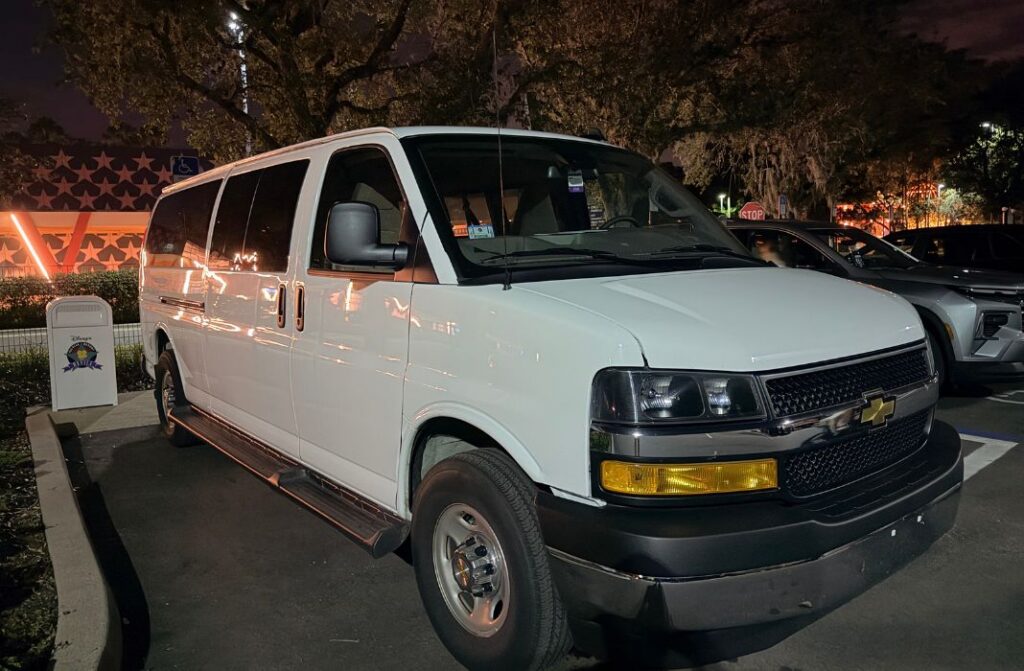
No CarPlay. No fancy technology. Just a massive van.
Once inside, I discovered the Chevrolet wasn’t exactly overloaded with modern technology.
There was no Apple CarPlay. No huge central touchscreen. No clever navigation display.
We had a radio.
And that was basically it.
The gear selector was on the steering column, although that wasn’t completely alien because my Mercedes back home has a column-mounted selector. The Chevrolet’s version was considerably more agricultural.
Visibility wasn’t brilliant either. It was, after all, a van.
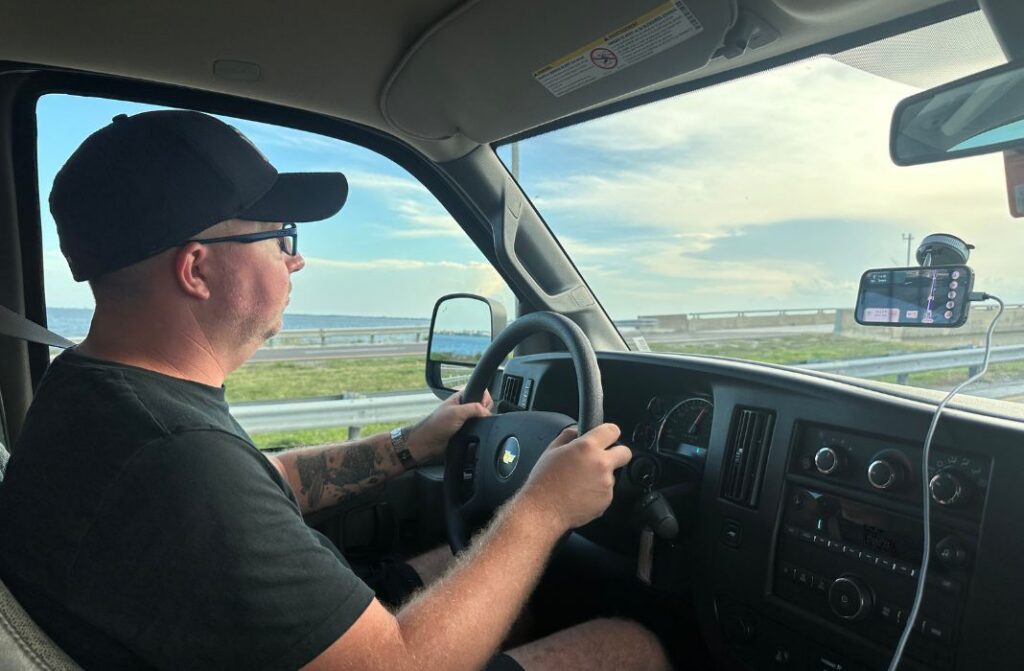
We’d hired a separate sat-nav, although not directly from Avis, but it felt dated and clunky compared with using a phone. Google Maps quickly became our main navigation system, so the phone was mounted where I could see it clearly.
Then came the moment I’d been thinking about for weeks.
Time to actually drive it.
My biggest tip? Be confident
Driving on the right for the first time feels weird.
There’s no way around that.
Your brain has years of experience telling you where a car should be positioned on the road and suddenly you’re asking it to do something completely different.
I definitely favoured one side of the lane more than the other at first. My wife became my second pair of eyes, telling me when I was getting too close to the line and helping me judge where this enormous Chevrolet was sitting.
But one thing quickly became obvious.
Confidence goes a long way.
Even if you have to fake it.
If you become nervous about every junction, lane change or turn, I found it much easier to start second-guessing myself.
Take your time, pay attention and commit to what you’re doing.
And if you make a mistake?
It’s really not the end of the world.
I came off at the wrong exit at one point. It was annoying. Google Maps recalculated the route, we eventually looped back around and carried on.
Nobody died.
Nobody even mentioned it five minutes later.
Probably.
The size takes more getting used to than the side of the road
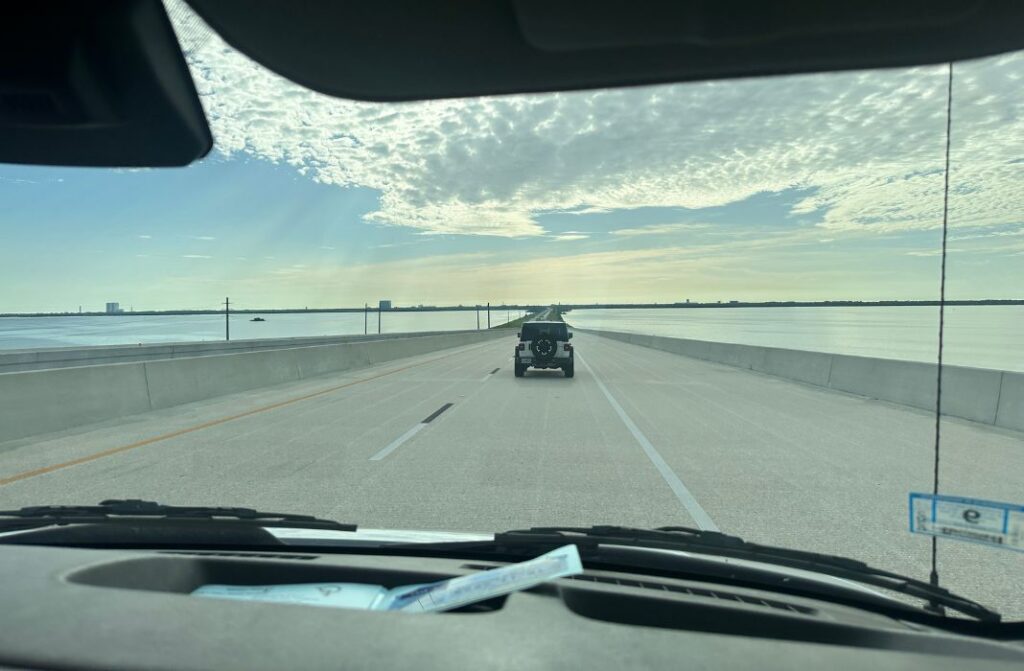
Oddly, after a while, driving on the right wasn’t the thing I was thinking about most.
It was the size of the Chevrolet.
You have to get used to the width, but you also have to remember just how much vehicle is behind you.
Changing lanes was probably the thing I remained most cautious about throughout the holiday. I wanted to know there was plenty of space before moving across.
That’s relatively easy on a quiet road.
In heavier traffic, it’s more difficult.
Sometimes you have to indicate, wait and rely on someone being kind enough to create a gap. You also start trusting the judgement of other drivers. If they’re willing to let you into the space, that’s a useful indication that you’ve probably got enough room.
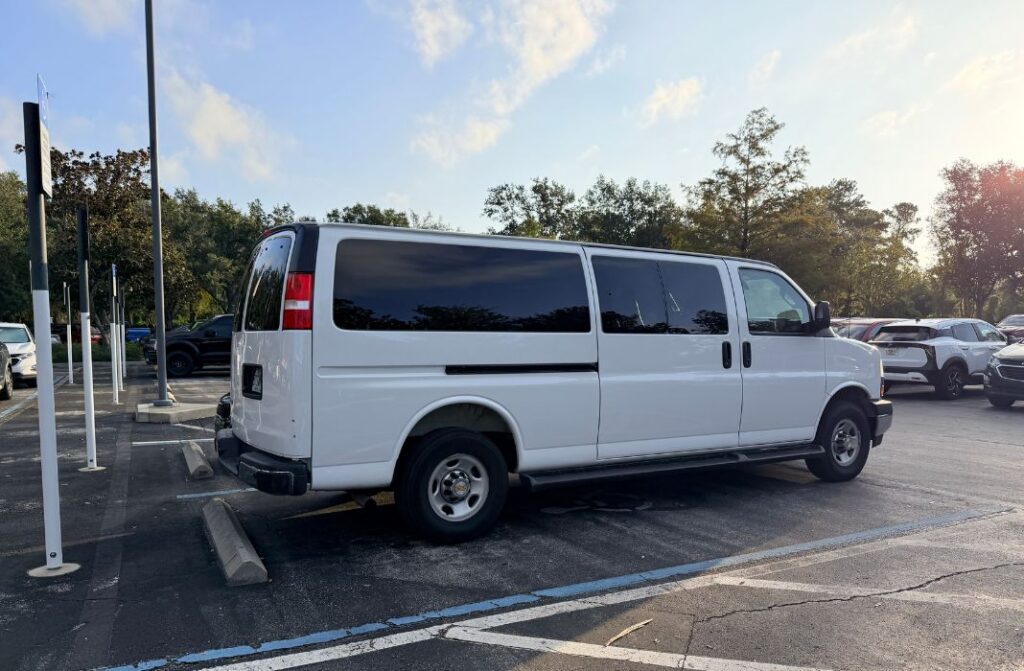
The Chevrolet did have a reversing camera and parking sensors, thankfully, although the camera display was tiny.
Fortunately, American parking spaces generally felt massive compared with those back home. Lots of spaces also had concrete wheel stops, which gave me another useful reference point when parking something roughly the size of a terraced house.
American roads weren’t the only thing I had to learn
Something I hadn’t really thought about beforehand was getting used to the way the vehicle itself drove.
This wasn’t my Mini JCW, Tesla or Mercedes.
The Chevrolet had a big engine and plenty of torque, particularly when loaded, but its response wasn’t immediate. You had to learn how much throttle it wanted and how quickly it would react.
That’s another reason I’d recommend giving yourself time during those first few journeys.
You’re learning two things at once.
You’re learning American roads and you’re learning an unfamiliar vehicle.
Hazard awareness feels different. Junctions look different. Traffic lights can be positioned differently from what you’re used to. Cars can pass you on different sides. Even something as simple as looking in the right direction when pulling out requires more conscious thought initially.
But it does start becoming normal surprisingly quickly.
Nine people and all their stuff
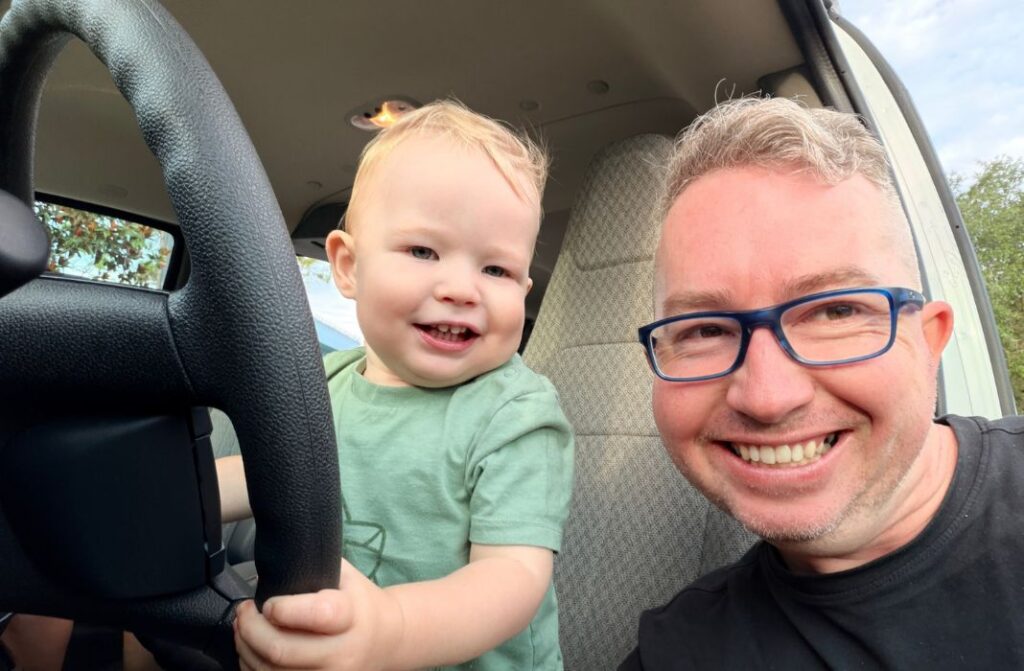
One area where the Chevrolet absolutely earned its keep was practicality.
We had nine people on board, five of them children.
We had a child’s car seat.
A wheelchair.
Around eight suitcases.
Then there were all the backpacks and other bits and pieces that inevitably come with taking a large family on holiday.
It swallowed the lot.
More impressively, when it was fully loaded, it never really felt like it was struggling. The engine just got on with the job.
It might not have had CarPlay or many of the creature comforts I’m used to, and you felt like you were sitting approximately a million feet above the road, but it held up its end of the bargain.
What about filling up?
I had also read various horror stories online about buying fuel in America.
One piece of advice I’d seen suggested that foreign cards wouldn’t always work at the pump, meaning you’d have to go into the petrol station, guess how much fuel you wanted, pay perhaps $40 upfront, fill the vehicle and then go back inside afterwards if you’d paid too much.
Thankfully, I never needed to find out how awkward that process might be.
The petrol stations we used allowed us to pay at the pump without any major drama.
We only needed to fill the Chevrolet a couple of times during the holiday and returned it close to empty, so fuelling turned out to be much easier than I’d expected.
Where did we actually drive?
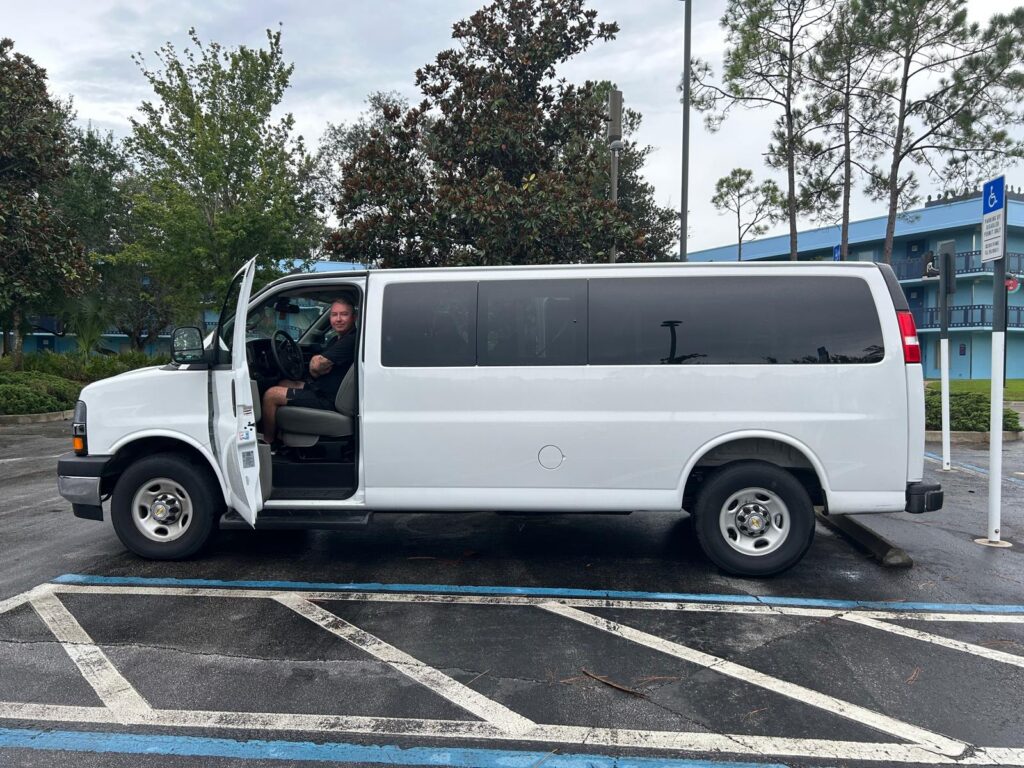
We weren’t exactly attempting Route 66.
Staying at Disney’s All-Star Movies Resort meant a lot of what we wanted was relatively close, which made life much easier.
But we still managed some proper journeys.
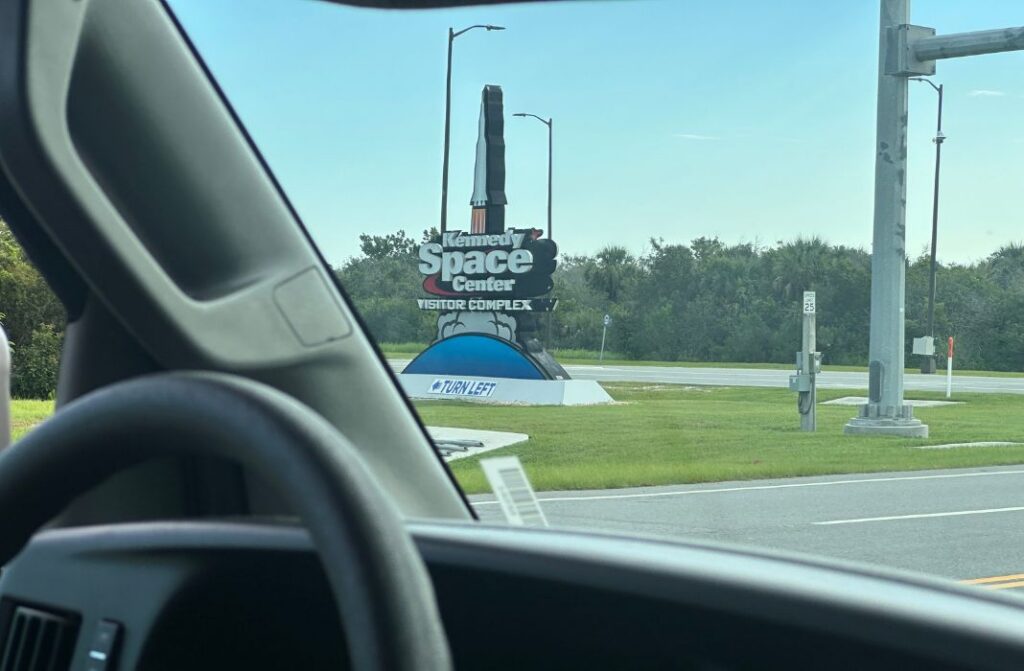
We drove out to Kennedy Space Center, which was probably the biggest test of my newly discovered American driving confidence.
We also headed to Ron Jon Surf Shop and Cocoa Beach.
By American standards, the mileage we covered was probably nothing particularly exciting.
For someone driving in America for the first time, in a 12-seater van full of family members, it felt like enough.
And we survived.
How much did it cost?
The main vehicle hire, including the separate sat-nav hire, came to £1,238.50.
The child seat wasn’t cheap either. Avis charged me another £263.41, although looking back at the bill I’m not entirely sure how much of that was specifically the child seat and whether there were additional insurance or other charges included.
It certainly wasn’t a cheap way of getting around.
But when you divide the cost across nine people and consider the convenience of having everyone and everything in one vehicle, I still think we made the right choice for this particular holiday.
Would I drive in America again?
Absolutely.
In fact, that’s probably the biggest thing I took away from the whole experience.
Before the holiday, driving in America felt like a big deal.
Driving on the opposite side of the road. Sitting on the opposite side of the vehicle. Different road rules. Different junctions. Different driving habits.
And I’d somehow decided that my introduction to all of this should involve one of the largest passenger vehicles Avis could give me.
Looking back, I’m still not entirely sure how I did it.
Actually, I do.
Preparation helped. Google Maps helped enormously. My wife sitting next to me helped even more. Having everyone else in the vehicle understanding that I needed to concentrate during those first few journeys helped too.
But doing it has given me a huge amount of confidence.
It genuinely changes the landscape for future holidays.
Hiring a car abroad? Fine.
Driving on the other side of the road? I’ve done it.
Picking up something unfamiliar from an airport and heading off into the darkness? Been there too.
Next time, though, perhaps I’ll start with something a little smaller than a 12-seater Chevrolet Express.
A Mustang sounds nice.
